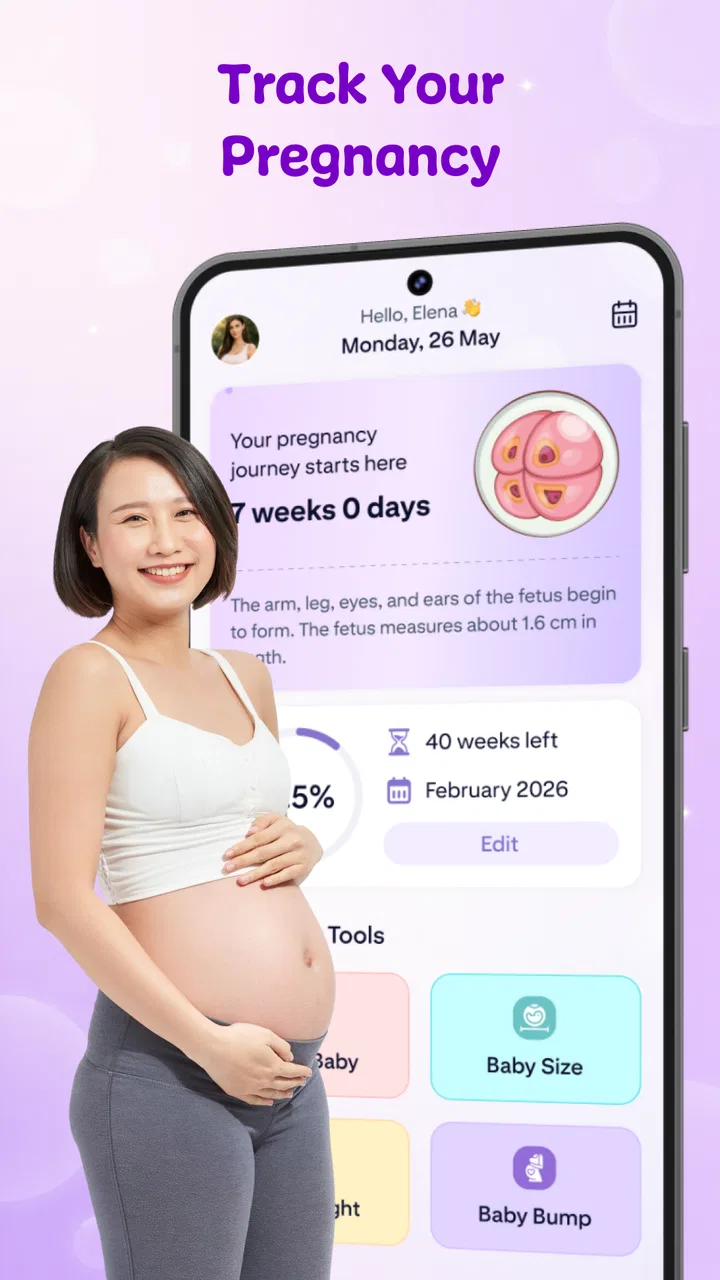
Baby Love : Pregnance Tracker
- 0.0
- Rating
- 10.00K
- Installs
- Free
- Price

 Analysis by App-foxy
Baby Love: Pregnance Tracker takes a simple, reassuring approach to pregnancy organization. Instead of trying to be an all-purpose medical reference, it focuses on the parts many expectant parents actually want to follow from week to week: pregnancy progress, baby growth, the due date, and personal moments worth remembering. I found that focus useful because it keeps the experience centered on the changing rhythm of pregnancy rather than burying the user under unrelated tools.
My overall view is positive, with an important qualification: this is best treated as a personal tracking companion, not as a replacement for professional prenatal care. That distinction shapes almost everything about the app. If you want a calm place to follow your journey and record meaningful memories, it is easy to understand. If you need detailed medical guidance, extensive planning tools, or a highly customizable health dashboard, you may eventually want something more specialized.
How the week-by-week experience works in everyday life
The most natural way to use Baby Love is as a small weekly check-in. Rather than opening it only when you have a question, I would make it part of a regular routine: check the current stage, look at the baby-growth information, confirm the due-date timeline, and add a note or memory while the details are fresh. That turns the app from a passive reference into a simple record of the pregnancy.
You May Also Like

 Blood Strike: 2.5 Anniversary
Blood Strike’s Loadouts Turn Every Drop Into a Tactical Gamble
A close look at Blood Strike’s custom loadouts: how fast access to signature weapons reshapes its battle royale rhythm, rewards preparation, and narrows the gap between fights.

 Pandora - Music & Podcasts
Pandora’s Music Is Easy to Start, but Harder to Recover
Pandora’s strength is its low-effort path from a seed to a station. Its weak spot is how much confidence it asks you to place in connection, setup, and quiet recovery.

 8 Ball Pool
 Is Built on Rivalries, Rematches, and Routine
A close look at the rivalries, rematches, shared routines, and unanswered safety questions that turn a quick pool match into a persistent mobile community.

 Samsung Music
’s Quiet Strength Is Playing What You Already Own
Its reach comes less from spectacle than from dependable access to a personal library. That simplicity is both the app’s strongest retention engine and its ceiling.

 AccuWeather: Weather Radar
AccuWeather Review: A Quick, Clear Forecast for Everyday Decisions
For everyday plans, the best forecast is the one you can understand quickly. AccuWeather makes rain timing, radar, and local conditions easy to act on, with a few trade-offs.

 Hill Climb Racing
Why Hill Climb Racing Still Turns Crashes Into One More Run
A tiny car, a bumpy hill and one more upgrade: Hill Climb Racing keeps resurfacing because its simple chaos makes every near-miss feel personal.
More From Our News Desk
View All News


The week-by-week structure is particularly helpful for people who find pregnancy easier to understand as a sequence of manageable stages. A due date can feel distant and abstract, while a current week gives the experience a more immediate frame. The app’s design idea is therefore practical even before considering any individual feature: it gives the user a reason to return without demanding constant attention.
I also like the balance between information and memory keeping. Many pregnancy tools concentrate heavily on symptoms, appointments, or clinical terminology. Baby Love gives equal attention to special moments, which makes it more personal. An appointment, a first scan, a family announcement, or a small emotional milestone can become part of the same timeline as the pregnancy progress.
That combination creates one of the app’s strongest advantages. Its real value is the connection between tracking the pregnancy and remembering how it felt. A conventional calendar can hold appointments, and a notes app can store thoughts, but neither is naturally organized around the changing pregnancy week. Here, the context matters because a memory is attached to a particular point in the journey.
For a realistic everyday scenario, imagine opening the app on a quiet weekend after a busy week. You can use the current pregnancy stage as a prompt to pause, review what has changed, and write down a short memory before the details disappear into daily life. Later, that note may be more meaningful than a generic photograph because it preserves what was happening emotionally at that moment.
A useful routine for keeping the record meaningful
I would avoid trying to document everything. The app works better when entries are selective. A short note about an important conversation, a new feeling, or a memorable appointment is easier to maintain than a demand to write a full diary every day. This is a useful trade-off: less pressure makes it more likely that the record will continue across the entire pregnancy.
Another practical approach is to use a consistent format for personal entries. I would record the date, the pregnancy week, what happened, and one sentence about how I felt. That structure makes later memories easier to understand, while keeping the process quick. The app’s week-by-week organization supplies the framework; the user’s restraint supplies the clarity.
People sharing the pregnancy with a partner or family member can also use the weekly view as a conversation starter. Instead of saying only that time is passing quickly, the current stage gives both people something concrete to discuss. It can help a partner who is not experiencing the physical changes feel more connected to the timeline, although the app should not be mistaken for a shared care-management system.
That last point matters. I see Baby Love as primarily personal. It can support conversations, but I would not rely on it as the central place for medical instructions, appointment coordination, or urgent communication. Those responsibilities belong with healthcare professionals and the tools already used by a clinic or care team.
What makes the focus stronger than a generic notes app
The advantage over a standard notes application is not necessarily complexity. It is relevance. A blank notes page asks the user to invent a system, decide what to track, and remember how entries relate to the pregnancy. Baby Love starts with the pregnancy journey as the organizing idea, so the user can spend less time designing a filing system.
The same is true when comparing it with a basic calendar. A calendar is excellent for appointments and deadlines, but it does not naturally express baby growth or the emotional story of the pregnancy. Baby Love is better suited to reflection, while a calendar remains better for scheduling. In my view, the two tools solve different problems rather than competing directly.
Compared with larger pregnancy platforms, the appeal is the narrower scope. A feature-heavy alternative may offer more sections, alerts, articles, or health inputs, but that can also create clutter. Baby Love is more attractive to someone who wants the essentials in one pregnancy-centered place and does not want every opening of the app to feel like administrative work.
That simplicity comes with a cost. Users who enjoy detailed charts, extensive symptom logging, appointment management, or broad educational libraries may find the experience less complete than a full pregnancy suite. I would choose a more comprehensive alternative when the main goal is managing many kinds of health information rather than following progress and preserving memories.
Where the app needs a careful reading
The biggest limitation is the boundary between friendly tracking and medical advice. Pregnancy information can be reassuring, but reassurance should never override a concern that needs professional attention. I would not use the app to interpret alarming symptoms, make treatment decisions, or decide whether medical care is necessary. Its role is supportive and organizational, not diagnostic.
This also means that the app’s simplicity may feel limiting for users who want a personalized clinical record. A person managing a complicated pregnancy, monitoring specific health factors, or coordinating care between several professionals may need tools designed for those tasks. Baby Love can still serve as a personal memory space, but it should not be expected to carry the full burden of care planning.
There is another subtle limitation in any week-based tracker: the week can become the focus instead of the person’s actual experience. Pregnancy does not always follow a neat emotional or physical schedule. I would use the week as a guide, not as a rulebook. If the app encourages comparison with an imagined “normal” journey, it is worth stepping back and treating its timeline as orientation rather than judgment.
The experience also depends on regular engagement. A tracker cannot preserve memories that are never entered, and a weekly view cannot replace the habit of checking in. This is not a flaw unique to Baby Love, but it affects the recommendation. Someone who dislikes journaling or rarely returns to personal apps may get more practical value from a simple calendar and camera roll.
Privacy is another reason to use thoughtful habits. Personal pregnancy notes can be sensitive, so I would avoid writing anything that I would not want visible if the phone were shared or left unlocked. I would also keep important medical documents and instructions in the official channels provided by healthcare professionals. Baby Love is most useful when it complements those arrangements rather than becoming the only record.
Who will get the most from Baby Love
I think the best audience is someone experiencing pregnancy for the first time or someone who wants a gentle record after finding more complicated apps overwhelming. The free price makes it easy to try without turning the decision into a financial commitment, and the Everyone content rating makes its presentation broadly approachable for families.
It can also suit a parent who values memories as much as milestones. If the idea of looking back at a week-by-week personal story sounds appealing, the app has a clear purpose. It is especially useful for users who want more structure than a blank journal but less intensity than a health-management platform.
Partners and relatives may find the timeline helpful as a way to stay engaged, but I would not describe it as a substitute for direct communication. The strongest use is still personal tracking, with selected memories shared in conversation when appropriate. That keeps the app from becoming another obligation for the expectant parent.
On the other hand, I would suggest skipping it if you are searching primarily for emergency guidance, detailed prenatal education, or a robust appointment and medication system. A dedicated medical resource or clinic-provided platform will be a better fit for those needs. I would also look elsewhere if you want a highly social experience or a large community built into the same product.
Practical details and long-term usability
Baby Love is developed by ZUZA SOFTWARE LIMITED and is available as a free parenting app. Its current release is version 1.0.0, which gives it a straightforward starting point but also suggests that users should keep their expectations measured. I would approach it for its central tracking idea rather than assuming it already covers every possible pregnancy workflow.
The app has passed the early adoption stage with over ten thousand installs, enough to show that the concept has found an audience while still leaving room for it to grow. It supports devices running Android seven or later, so many older Android phones can use it without requiring a recent handset. That is helpful for families who keep an older device as a personal phone or do not upgrade frequently.
The store short description, “Baby Love,” is brief, but the product itself is easier to understand through its practical purpose: it is a pregnancy companion for following progress, baby growth, the due date, and special memories. I would not judge it by the short wording alone. The important question is whether that focused set of tasks matches the way you want to document the experience.
Because it is free, the trial decision is simple. I would install it, establish a small weekly routine, and see whether the timeline encourages useful reflection after a few check-ins. If it becomes another icon that is opened once and forgotten, the problem is probably a mismatch of habits rather than a missing advanced feature. The app rewards light, consistent use more than intense setup.
One tip I found valuable is to decide in advance what belongs in the app and what belongs elsewhere. Use Baby Love for the pregnancy story and personal milestones. Use a calendar for appointments, a secure medical channel for clinical information, and a separate backup method for irreplaceable photographs or documents. This division prevents the tracker from becoming overloaded and makes each tool easier to trust.
A second useful trade-off is deciding whether to write immediately or retrospectively. Immediate notes capture emotion more accurately, but a weekly review can produce a cleaner record. I would combine both: make a very short note when something meaningful happens, then use the weekly check-in to add context. That workflow keeps memories from being lost without turning the app into a daily assignment.
A third insight is that the due date should be treated as a planning reference, not a promise. The value of the date is that it gives the journey a shared horizon for personal planning and conversations. It should not create pressure if the pregnancy does not unfold according to an imagined schedule. The app can organize time, but it cannot define the experience.
My recommendation after using it as a pregnancy companion
Baby Love succeeds because it understands that pregnancy tracking is not only about counting weeks. It is also about making a changing, sometimes overwhelming experience easier to revisit. The combination of progress, baby growth, due-date awareness, and special moments gives the app a clear identity, and I prefer that clarity to an overloaded dashboard.
Its weakness is equally clear: the focused design will not satisfy everyone. Users who need clinical depth, extensive customization, or a complete family-planning system should choose a more specialized alternative. Even users who like Baby Love should keep professional care and official medical records at the center of their routine.
For me, the final verdict is that Baby Love is worth trying for expectant parents who want a simple, personal week-by-week record. It is free, approachable, and most effective when used in small, regular sessions rather than as a source of constant information. I recommend it as a memory-minded pregnancy tracker, provided you use it alongside—not instead of—professional prenatal care.
FAQs for Baby Love : Pregnance Tracker
01What is Baby Love: Pregnancy Tracker used for?
Baby Love: Pregnancy Tracker is designed to help expectant parents follow pregnancy progress week by week. It may provide information about fetal development, pregnancy milestones, appointment planning, reminders, checklists, and general wellness guidance. The app is best viewed as an organizational and educational companion rather than a replacement for personalized advice from an obstetrician, midwife, or other qualified healthcare professional.
02Does Baby Love: Pregnancy Tracker calculate my due date accurately?
The app can usually estimate a due date after you enter information such as the first day of your last menstrual period or another pregnancy date. This calculation is an estimate and may differ from the date confirmed by your healthcare provider, particularly when cycles are irregular or conception timing is uncertain. Always use your doctor’s ultrasound assessment and clinical advice as the most reliable reference.
03What kind of pregnancy information and tracking tools are included?
Depending on the version and device, Baby Love: Pregnancy Tracker may include weekly pregnancy updates, baby-development descriptions, size comparisons, symptom or mood tracking, weight monitoring, appointment reminders, kick counters, contraction timers, and preparation checklists. Available tools can vary by platform, region, subscription status, and app updates, so reviewing the current store description is recommended before downloading.
04Is Baby Love: Pregnancy Tracker medically reliable and safe to use?
The app can be useful for learning basic pregnancy concepts and organizing personal notes, but it should not be treated as a diagnostic or emergency medical tool. Information in pregnancy apps is generally broad and cannot account for your medical history, complications, medications, or individual risks. Contact a healthcare professional for concerning symptoms, and seek urgent care for emergencies instead of relying on an app.
05Is Baby Love: Pregnancy Tracker free, and does it require an account?
Baby Love: Pregnancy Tracker may be available as a free download while offering optional in-app purchases, premium content, advertising, or subscription features. Some functions may require creating an account, entering pregnancy details, or granting permissions such as notifications. Before confirming a subscription, check the app store listing for current pricing, renewal terms, cancellation instructions, privacy information, and supported devices.
Pros
- Clear week-by-week pregnancy information for expecting parents.
- Helpful reminders for appointments
- tests
- and important pregnancy milestones.
- Simple interface that is easy to navigate during daily use.
- Useful tools for tracking symptoms
- weight
- and pregnancy progress.
- Can help users prepare questions and topics for prenatal visits.
Cons
- Some features or content may require a premium subscription.
- Pregnancy estimates depend on accurate dates entered by the user.
- Information should not replace advice from a qualified healthcare professional.
- Notification settings may feel excessive if too many reminders are enabled.
- Privacy concerns may arise when entering sensitive health and pregnancy data.

Baby Love : Pregnance Tracker
Gallery